
Demographics




A Melting Pot of People: ‘One of America’s Friendliest Cities’
Who are we? For starters, we’re friendly. In fact, we were named one of America’s friendliest cities by Travel & Leisure magazine. We’re down-to-earth, hard-working and like to have fun. We thrive because we are a diverse community that celebrates our past, present and future.
Once known as a “melting pot” that drew its strength from the varied immigrant groups who planted roots here hoping to find opportunity, peace and prosperity, Milwaukee can now be seen as a nexus that connects individuals from various backgrounds to create a vibrant and strong urban environment. The metropolitan region is 66% White, 17% Black, 12% Hispanic/Latino and 4% Asian. Thirty-five percent of the total population identify as having German ancestry, 11% Polish, 10% Irish, 4% English and 4% Italian. Among the Hispanic population, 68% identify as having Mexican ancestry and 23% are of Puerto Rican descent. Among the Asian population, 28% are Hmong, 27% are Indian and 13% are Chinese.
Residents often discover that Southeastern Wisconsin delivers many of the amenities associated with larger metropolitan regions—professional sports, world-class festivals, nationally recognized museums, excellent healthcare and higher education institutions—without the housing costs, congestion and lengthy commutes found in many larger markets.
Milwaukee embraces the distinct character of its various heritages by hosting a cavalcade of ethnic festivals throughout the year, bringing together the larger community to celebrate the unique contributions and traditions of each group. Larger festivals rotate through the lakefront Henry W. Maier Festival Park, including Polish Fest, German Fest, Mexican Fiesta and Irish Fest.
In fact, Milwaukee’s lakefront festival grounds host one of the largest collections of ethnic festivals in North America. Additional celebrations throughout the region include Festa Italiana, Juneteenth Day Celebration, Black Arts Fest MKE, IndiaFest, Serbian Days, Bastille Days and numerous community heritage celebrations held throughout the year.
Milwaukee is home to a large, vibrant and active LGBTQ+ community that offers engagement, support resources, film festivals and social events, including PrideFest Milwaukee, an annual celebration held on Milwaukee’s lakefront. One of the nation’s longest-running Pride celebrations, PrideFest draws visitors from throughout the Midwest and reflects the region’s welcoming and inclusive spirit. Numerous community organizations, social groups, professional networks and inclusive faith communities help foster a supportive environment for residents and visitors alike.
Southeastern Wisconsin By The Numbers
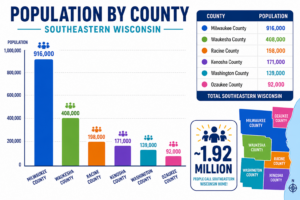
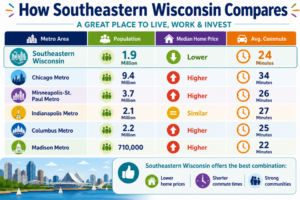
Southeastern Wisconsin encompasses Milwaukee, Waukesha, Ozaukee, Washington, Racine and Kenosha Counties and is home to approximately 1.9 million residents. The region combines the cultural energy of a major metropolitan area with the affordability, accessibility and quality of life often associated with smaller communities.
Ideal for All Ages & Stages
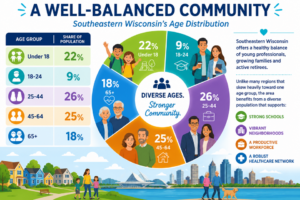
The Milwaukee Region is an ideal place to start a career, raise a family or enjoy the freedom retirement brings.
For Those Starting Out
An energetic, but walkable downtown teeming with new apartments, condominiums and restaurants makes Milwaukee a choice destination for young professionals. The city offers affordable housing, professional sports teams, rich cultural offerings, a vibrant music scene (including Summerfest, the world’s largest music festival), and plenty of opportunities to enjoy the outdoors (including miles of beaches, abundant green space, a riverwalk and a lakefront state park within walking distance of the downtown). The city’s low unemployment rate, its rapidly developing technology clusters, and its premier colleges and universities make it a perfect place to start or grow a career.
For Families
Excellent schools, a wide variety of safe communities and plenty of kid-friendly activities make Milwaukee a wonderful place to raise a family. In addition to having one of the nation’s largest park systems, the Milwaukee Region has several attractions curated with kids (and kids at heart) in mind: Betty Brinn Children’s Museum, Discovery World Science + Technology Center, Milwaukee Public Museum/Daniel M. Soref National Geographic Dome Theater & Planetarium, the Mitchell Park Domes, Milwaukee Art Museum, Boerner Botanical Gardens, Old World Wisconsin and the Milwaukee County Zoo, to name just a few. Wisconsin schools consistently rank among the better performing institutions in the nation and the area offers a variety of excellent faith-based and private schools as well.
For Retirees
Given its cold winters, Milwaukee scores surprisingly high as a preferred destination for retirees. One reason is its affordable cost of living. Home prices won’t consume your life savings, dining out is not expensive, and one can even take college classes for free within the University of Wisconsin system (the University of Wisconsin-Milwaukee campus, the second largest in the state, is located just north of downtown Milwaukee). Then, of course, there are abundant indoor and outdoor activities – the symphony, theater and opera, as well as golf, tennis, miles of hiking trails, and rivers and lakeside beaches to explore. The list is endless. And who says you can’t enjoy winter? You may not be up for the polar-bear plunge, but how about cross-country skiing or snowshoeing?
Household Composition & Lifestyle Comparison
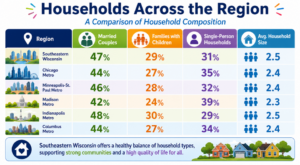
One of Southeastern Wisconsin’s greatest strengths is the balance it offers between urban living, family-friendly communities and opportunities for retirees. Compared with many large Midwest metropolitan areas, the region has a higher percentage of family households while maintaining vibrant urban neighborhoods that appeal to young professionals and empty nesters.
Southeastern Wisconsin’s household profile reflects one of the region’s biggest advantages: variety. Residents can choose from downtown lofts and condominiums, walkable historic neighborhoods, lakefront communities, suburban developments and rural properties, all within a relatively short drive of one another.
Compared with Madison, Southeastern Wisconsin has a larger percentage of family households and fewer single-person households, reflecting its broader mix of suburban and family-oriented communities. Madison’s large university population contributes to a younger demographic and a higher concentration of renters and single adults.
Compared with Chicago, residents enjoy more housing choices at lower price points, larger average lot sizes and significantly shorter commute times. While Chicago offers the advantages of a global city, Southeastern Wisconsin provides many of the same cultural amenities—including professional sports, museums, performing arts and major festivals—while maintaining a more manageable cost of living.
Where The Waters Meet:
A brief history of the Milwaukee Region
Native Americans were the first to realize the beauty of Milwaukee’s location at the mouths of the Kinnickinnic, Menomonee and Milwaukee rivers. They called it “Milwaukie,” which means “where the waters meet.” Its natural harbor and lightly wooded bluffs made it a perfect location. By 1817, Milwaukee was already a cosmopolitan village with an estimated 300 people representing a variety of tribes, including the Sac, Fox, Chippewa, Ottawa, Winnebago, Menomonee and Potawatomi. They speared fish in the three rivers and grew wild rice in the grassy swamps where Milwaukee’s downtown now stands.
One of the first known Europeans to visit the area was Jesuit missionary Father Jacques Marquette, who camped here in 1674. He was soon followed by fur trappers drawn to the area by its wealth of natural resources. Native Americans and fur trappers kept a cautious distance from each other, but from time-to-time indigenous peoples helped fight white men’s wars, most notably the Revolutionary War and the War of 1812.
Germans were among the city’s first immigrants, and they soon dominated the city. By 1850, one-third of the city’s population was German and by the early 1900s, the city was referred to as the “German Athens of America.” The city’s South Side Polish population was the second largest ethnic group.
Milwaukee’s first African-American church dates back to 1869, but the city’s African-American community did not start growing rapidly until after World War I. The first Hispanic people arrived in the early 1920s, when local tanneries recruited men from Mexican villages. Milwaukee’s economy grew rapidly between 1940 and 1980, and its metropolitan population increased 59 percent, to 1.4 million people.
At the beginning of the 1980s, Milwaukee was one of the leading manufacturing cities in the country. Allis-Chalmers, Harnischfeger, Briggs & Stratton, Harley-Davidson, A. O. Smith, Allen-Bradley and Bucyrus-Erie had made the city famous. The local economy’s dependence on manufacturing jobs left it vulnerable to the manufacturing recession of the late 1970s and early 1980s, when tens of thousands of people lost their jobs as factories closed or moved their operations out of the state.
Since then, Milwaukee has rebuilt its economy, this time with a diversified base and an increased emphasis on exports. It has also become a leader in the development of e-commerce and green technologies. This shift to service-based industries has offered some protection against severe swings in manufacturing cycles.
If you’re looking for more detailed information about the region’s colorful history, visit themakingofmilwaukee.com, which features video history segments assembled by noted historian John Gurda or explore the Encyclopedia of Milwaukee digital humanities project at emke.uwm.edu.