

Job Data


Labor Market Overview Milwaukee, Waukesha, Washington, Ozaukee, Racine, and Kenosha Counties
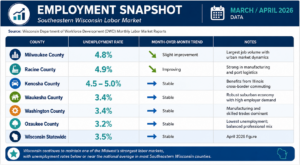
The six-county southeastern Wisconsin region (Milwaukee, Waukesha, Washington, Ozaukee, Racine, and Kenosha) maintains a resilient labor market in 2026. Low unemployment, stable employment levels, and strong long-term growth projections through 2032 make this area attractive for job seekers and employers. Key drivers include an aging population boosting healthcare, regional investments in advanced manufacturing, bio health, logistics, clean energy, and data centers.
Total Nonfarm Employment
- Milwaukee-Waukesha Metro Core: 850,000 – 856,000 jobs
- Broader Six-County Region: Additional strong employment in manufacturing (Racine & Kenosha), warehousing/logistics, healthcare, and professional services.
- Trend: Slight year-over-year moderation in some sectors, but healthcare and manufacturing provide consistent stability.
How to Use WisConomy for Personalized Research
WisConomy (available at: jobcenterofwisconsin.com/wisconomy) is Wisconsin’s premier free labor market information tool. Here’s a step-by-step guide to using it effectively:
- Visit the Website — Go to jobcenterofwisconsin.com/wisconomy.
- Select Your County — Use the county dropdown or map to choose Milwaukee, Waukesha, Washington, Ozaukee, Racine, or Kenosha.
- Explore Key Sections:
- County Profiles: View population trends, major employers, and economic overviews.
- Occupational Projections: Search growth rates to 2032 (e.g., Nurse Practitioners at +51%, Data Scientists at +43%).
- Wage Data: Compare average hourly and annual wages by occupation and county.
- Hot Jobs List: Identify high-demand roles with good pay and growth.
- Labor Supply & Demand: Analyze job openings versus available workers.
- Create Custom Reports — Use the tools to generate wage comparisons or living wage calculators tailored to your situation.
- Practical Tips:
- Compare your target occupation’s wages across all six counties.
- Check “Projected Job Openings” for both replacement and new growth positions.
- Use the data to negotiate salary offers or decide where to live (e.g., lower unemployment in Ozaukee vs. more opportunities in Milwaukee).
Long-Term Occupational Projections (to 2032)
Source: WisConomy & Wisconsin DWD
High-Growth Occupations:
- Healthcare — Nurse Practitioners (51%), Nursing Assistants, Technicians.
- Technology & Data — Data Scientists (43%), Software Developers, Computer Research Scientists.
- Trades & Energy — Wind Turbine Technicians (very high growth), Electricians, Carpenters, Automotive Technicians.
- Other — Management, Project Management, Accounting/HR, Community Services.
Emerging Opportunities:
- Advanced manufacturing & bio health (Milwaukee/Waukesha)
- Logistics & distribution (Kenosha/Racine)
- Clean energy and data centers (region-wide)
Cost of Living Context
- Overall cost of living: Near or slightly above national average (~1% higher).
- Housing is more expensive in desirable suburbs but offset by lower utilities and taxes.
- Tools: Combine MIT Living Wage Calculator with WisConomy data for accurate county comparisons.
Recommended Data Sources
- WisConomy – Primary tool for county-level insights.
- Wisconsin DWD – Monthly reports.
- BLS OEWS – Detailed wage statistics.
- Employ Milwaukee – Local job resources.
Temporary Staffing in Southeastern Wisconsin
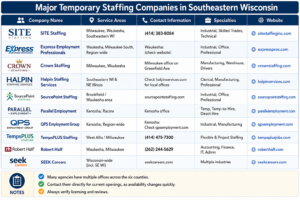
Temporary staffing agencies (also called temp agencies or staffing firms) are highly active in the region. They provide temporary, temp-to-hire, and direct hire placements across manufacturing, healthcare, logistics, administrative, skilled trades, and professional roles.
Benefits of Temporary Staffing
For Job Seekers / Employees:
- Quick entry into the workforce — often within days
- Flexibility to choose shifts, locations, and duration
- Opportunity to gain experience across multiple companies and industries
- Potential pathway to permanent employment (many temp-to-hire positions)
- Skill development and resume building
- Access to a wide variety of assignments while seeking long-term roles
Temporary workers in Wisconsin receive the same workers’ compensation protections as permanent employees.