

Faith and Fellowship




Faith & Fellowship
Milwaukee has a highly diverse religious landscape, shaped by historic European immigration, newer global migration, and established urban faith communities.
It has often been referred to as “City of Steeples,” which comes from its rapid growth during the 19th and early 20th centuries, when large waves of German, Polish, Irish, and other European immigrants settled in the city. During this period, neighborhoods were organized around ethnic parishes that served not only as places of worship but also as schools, social centers, and hubs of community life. As a result, church buildings were central to neighborhood identity and were often constructed as prominent, enduring landmarks. Many of these churches featured tall spires that became highly visible elements of the urban landscape, especially in working-class residential areas. Architecturally, this led to a cityscape where church steeples rose prominently above neighborhoods, creating a distinctive visual rhythm across Milwaukee’s skyline.
Today, Milwaukee is predominantly Christian (60-70%), but the region is increasingly shaped by a large and growing non-religious population (25–35%) alongside small but stable Jewish, Muslim, Hindu, and Buddhist communities. The overall pattern is not one of a single dominant tradition, but of Christian majority coexistence with rising religious diversity and secularization, especially in urban and younger populations.
The Milwaukee area in particular reflects a broader Midwest trend: traditional European-influenced Christian roots layered with newer global religious diversity and a rising number of people who are not affiliated with any religion.
Breakdown of Major Religions in the Area
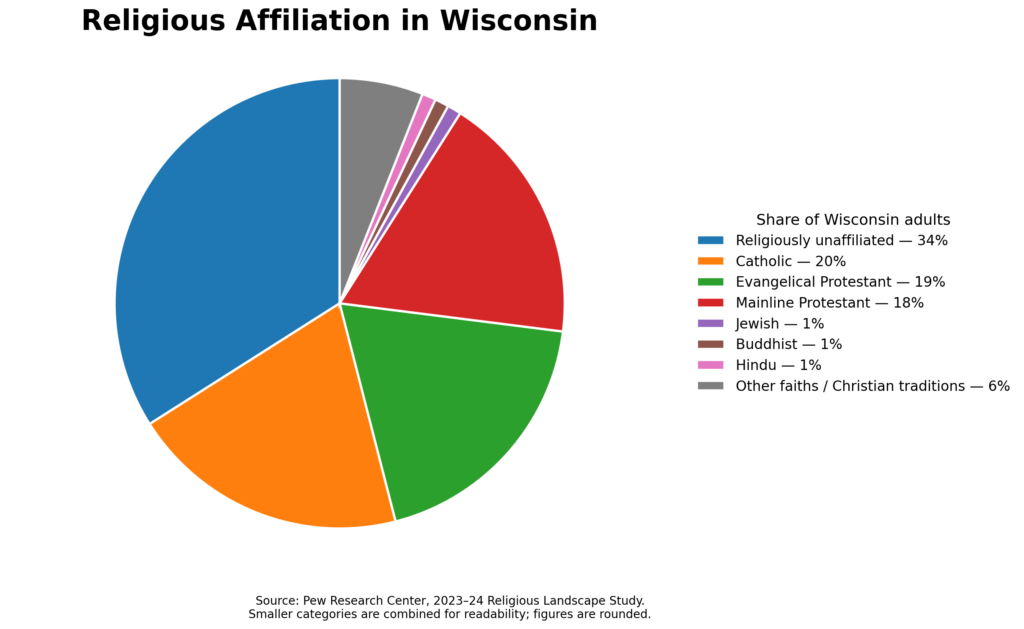
Christianity: 60–70%
Christianity is the dominant religious tradition in southeast Wisconsin, with significant variety:
- Roman Catholicism – Historically the largest single denomination in Milwaukee due to German, Irish, Italian, and Polish immigration
- Lutheran churches – Especially strong because of German and Scandinavian heritage (Wisconsin Evangelical Lutheran Synod, Lutheran Church-Missouri Synod, Wisconsin Evangelical Lutheran Synod – WELS, and Evangelical Lutheran Church in America – ELCA)
- Mainline Protestant churches – United Methodist, Presbyterian (PCUSA), Episcopal, and United Church of Christ
- Evangelical and non-denominational churches – Growing presence in suburban and exurban communities (Megachurch – Elmbrook with 7,000+ in weekly attendance, for instance)
- Orthodox Christianity – Smaller but established communities (Greek Orthodox, Russian Orthodox, etc.)
- Catholic: 25–35%
- Mainline Protestant (Lutheran, Methodist, Episcopal, etc.): 15–25%
- Evangelical/non-denominational Protestant: 15–25%
Catholicism remains especially strong due to historic German, Irish, Polish, and Italian settlement in Milwaukee.
Judaism: 1–2%
- One of the oldest non-Christian faith communities in the region
- Concentration in Milwaukee County and nearby suburbs
- Includes Reform, Conservative, and Orthodox congregations
- Active cultural and educational institutions, including synagogues, schools, and community centers
- Concentration in Milwaukee County and nearby suburbs
- Stable, long-established community with deep institutional roots
Islam: 1–2%
- One of the fastest-growing religious communities in the region
- Mosques and Islamic centers primarily in Milwaukee and nearby suburbs
- Diverse population including African American Muslims, South Asian, Middle Eastern, and East African communities
- Includes Sunni and smaller Shia communities
- One of the fastest-growing faith groups locally
- Highly diverse (African American, East African, South Asian, Middle Eastern communities)
Hinduism: 1% (or slightly under)
- Present largely due to South Asian immigration over the past few decades
- Temples and cultural centers serve families across the metro area
- Community events often include festivals like Diwali and Holi celebrations
- Small but growing South Asian community
- Centered around suburban temples and cultural organizations
Buddhism: Less than 1%
- Smaller but steady presence
- Includes Thai, Lao, Vietnamese, and Tibetan traditions
- Temples and meditation centers are located in Milwaukee and the surrounding suburbs
- Smaller communities (Thai, Lao, Vietnamese, Tibetan traditions)
- Present but not large in population share
Religiously unaffiliated (“nones”): 25–35%
- Includes atheists, agnostics, and “nothing in particular”
- This is one of the fastest-growing groups, especially among younger residents and urban populations
Other faiths and beliefs Less than 1%
- Unitarian Universalist congregations (religiously plural and humanist communities)
- Smaller communities of Baha’i, Sikh, and Pagan/earth-based traditions
- A significant and growing share of residents identifying as religiously unaffiliated (“nones”), especially among younger populations
- Includes Sikhism, Baha’i, Pagan/earth-based traditions, etc.
Milwaukee follows the broader Midwest trend of rising secularization, though it still trails the West Coast in “nones” percentage.
Notable Religious Sites in the Milwaukee Area
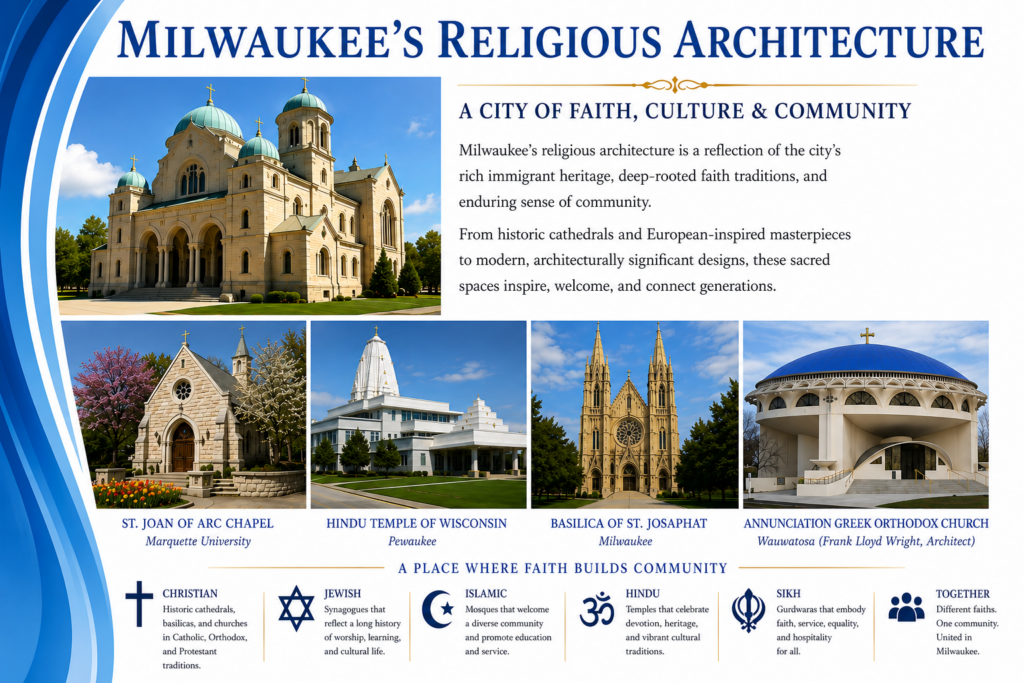
Milwaukee’s religious architecture is unusually prominent for a Midwestern city, reflecting its immigrant roots and long-standing parish-based community structure. The result is a landscape shaped by large-scale churches, distinctive styles, and nationally recognized design work. Collectively, these religious buildings are not only places of worship but also architectural statements of cultural identity, craftsmanship, and community investment, spanning styles from Gothic Revival and Baroque to modernist design.
Basilica of St. Josaphat
One of Milwaukee’s most iconic landmarks, this massive Polish Catholic Basilica is built in the style of St. Peter’s Basilica in Rome.
Why it’s special:
- Constructed in the late 1800s by Polish immigrants
- One of the largest copper-domed churches in the U.S.
- National Historic Landmark with extraordinary interior mosaics and stained glass
- Symbol of Milwaukee’s strong Polish heritage
Cathedral of St. John the Evangelist
The seat of the Roman Catholic Archdiocese of Milwaukee is located downtown.
Why it’s special:
- Spiritual center of Catholic life in southeastern Wisconsin
- Elegant Victorian Gothic architecture
- Hosts major diocesan ceremonies and civic events
- One of the oldest continuously operating Catholic parishes in the city
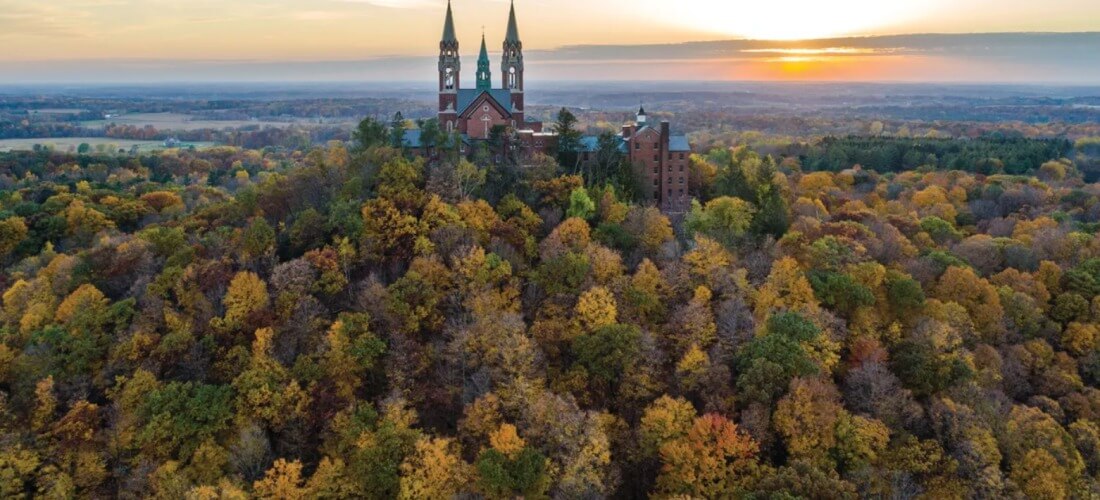
Basilica of Holy Hill
Basilica of the National Shrine of Mary Help of Christians at Holy Hill. Located just northwest of Milwaukee, this is one of the most visited pilgrimage sites in the Midwest.
Why it’s special:
- Built on one of the highest natural points in southeastern Wisconsin
- Stunning hilltop views across forests and farmland
- Major Marian pilgrimage destination
- Distinctive twin spires visible for miles
St. Joan of Arc Chapel (Marquette University)
Why it’s special:
- A 15th-century French chapel physically relocated stone-by-stone to Milwaukee
- Blends European medieval architecture with a modern university setting
- One of the most unique religious structures in the United States
Annunciation Greek Orthodox Church
This is one of the most significant modern religious structures in the Milwaukee area.
Why it’s special:
- Designed by Frank Lloyd Wright, completed after his death (1961)
- Distinctive “flying saucer” dome design unlike traditional Orthodox churches
- One of the only Wright-designed houses of worship still in regular use
- Interior emphasizes light, geometry, and simplicity rather than ornamentation
It is often cited as one of Wright’s most unusual sacred buildings anywhere.
St. Sava Serbian Orthodox Cathedral
Why it’s special:
- Built in traditional Serbian Byzantine Revival style
- Features onion domes and richly detailed iconography
- Strong cultural anchor for Milwaukee’s Serbian community
- Interior filled with hand-painted religious iconography
Congregation Emanu-El B’ne Jeshurun
Why it’s special:
- One of the oldest Jewish congregations in Wisconsin
- Historic Reform Judaism center in the region
- Strong cultural and educational programming
- Reflects Milwaukee’s long-established Jewish community
Islamic Society of Milwaukee Mosque
Why it’s special:
- One of the largest and most active mosques in the region
- Serves a highly diverse Muslim population (African American, Somali, Arab, South Asian communities)
- Central hub for education, interfaith dialogue, and community services
Hindu Temple of Wisconsin
Why it’s special:
- One of the main Hindu temples in the state
- Traditional North Indian temple architecture
- Major center for festivals like Diwali, Navratri, and Holi
- Serves a growing South Asian community across southeast Wisconsin
Sikh Temple (Gurdwara Singh Sabha Milwaukee)
Why it’s special:
- Key Sikh place of worship in the region
- Known for its open community kitchen (langar) serving free meals to all visitors
- Strong emphasis on community service and hospitality
Milwaukee’s religious architecture is unusually rich because it reflects both immigrant craftsmanship and nationally significant design figures like Frank Lloyd Wright. The region ranges from medieval European imports (like St. Joan of Arc Chapel) to Roman-inspired megastructures (St. Josaphat) to uniquely modernist sacred design (Annunciation Greek Orthodox Church). Together, they form one of the most architecturally diverse religious landscapes in the Midwest.
Fellowship and Getting Involved
Milwaukee has a fairly strong ecosystem of Christian fellowship networks, churches, and faith-based service groups, many of which combine worship, community, and hands-on outreach (helping the poor, homeless, refugees, and families in need). They range from large multi-church movements to very active local ministries. Many churches provide newcomers with opportunities to build friendships through small groups, volunteer service, Bible studies, and community outreach.
Large Non-Denominational & Evangelical Churches
Elmbrook Church — Brookfield
- Large, established non-denominational church serving the Milwaukee area from its Brookfield and Lake Country campuses
- Extensive small-group opportunities for young adults, men, women, couples, singles, young families and seniors
- Strong emphasis on both local and global mission, with opportunities to serve through community partners and mission programs
- Programs for children, middle- and high-school students, young adults and families, along with adult classes and care and support ministries
- Best for: newcomers seeking a large, established church with extensive programming, fellowship and opportunities to serve
Location: 777 S. Barker Road, Brookfield
Telephone: (262) 786-7051
Website: elmbrook.org
PERISSOS Church — Downtown Milwaukee
Formerly MIX Church
- Contemporary, non-denominational church meeting in Milwaukee’s Historic Third Ward
- Small groups provide opportunities to build relationships, study the Bible and connect outside of Sunday services
- Serve Saturday, held regularly throughout the year, brings members together to volunteer with organizations serving the Milwaukee community
- Contemporary worship and programming designed to build community among young adults, families and others living throughout the Milwaukee area
- Best for: newcomers seeking a contemporary urban church with an emphasis on relationships, small groups and hands-on community service
Location: 158 N. Broadway, Milwaukee
Telephone: (414) 501-3794
Website: perissos.church
Harvest Community Church — Oak Creek
- Non-denominational church with a strong emphasis on small groups, community and service
- Describes itself as a “church of small groups,” with groups meeting in homes and at the church throughout the week
- Local mission and community-service opportunities provide ways for members to serve beyond the church
- Programs include Harvest Kids, Harvest Youth, small groups, seasonal Bible studies and other adult ministries
- Regular newcomer gatherings provide an opportunity for those new to the church to meet members and learn how to become involved
- Best for: newcomers seeking a community-oriented church with strong small-group, family and service opportunities
Location: 6612 S. Howell Avenue, Oak Creek
Telephone: (414) 571-5040
Website: harvestcommunity.org
Catholic Parish Communities
Catholicism has deep roots in southeastern Wisconsin. The Archdiocese of Milwaukee, led by Archbishop Jeffrey S. Grob, encompasses 10 counties, 181 parishes and more than 500,000 Catholics. Its mother church is the historic Cathedral of St. John the Evangelist in downtown Milwaukee.
Catholic parishes throughout the region offer much more than weekly worship. Depending on the parish, newcomers can find men’s and women’s organizations, young-adult ministries, Bible studies and prayer groups, family and senior programs, parish festivals, volunteer opportunities, food pantries and other charitable outreach.
The Archdiocese also coordinates ministries supporting Catholic education, families, young adults, social justice, charitable service, vocations and other aspects of Catholic life throughout southeastern Wisconsin.
Best for: those seeking traditional parish life, intergenerational fellowship, faith formation and opportunities for community service.
Archdiocese of Milwaukee: archmil.org
Cathedral of St. John the Evangelist: 812 N. Jackson St., Milwaukee
Major Christian service & helping-hand ministries (very active volunteering)

These are some of the largest “hands and feet of faith” organizations in Milwaukee:
Capuchin Community Services
- Operates:
- St. Ben’s Community Meal (large daily meal service)
- House of Peace (food + clothing + hygiene support)
- One of Milwaukee’s most significant Christian-based poverty relief organizations
Best for: serving meals, direct poverty relief, high-impact volunteering
Kinship Community Food Center
- Community meals and food distribution
- Focus on dignity, shared meals, and relational volunteering
- Includes prayer and community gathering elements
Best for: relational volunteering (not just “task-based” service)
Morning Glory Ministries (Milwaukee South Side)
- Volunteer-run Christian nonprofit
- Weekly meals, pantry, clothing, toiletries
- Combines spiritual encouragement and practical help
Best for: consistent small-scale community service and fellowship atmosphere
Christian networks focused on outreach & city transformation
Cru Inner City – Milwaukee
- Partners with local churches
- Focus on discipleship, mentoring, and neighborhood outreach
- Strong volunteer pipeline for church-based service projects
Best for: structured mission work and mentorship
Interfaith Conference of Greater Milwaukee (includes Christian groups)
- Brings together churches + synagogues + mosques
- Works on:
- poverty relief
- racial reconciliation
- public service initiatives
Best for: broader fellowship + service across denominations
Milwaukee is somewhat unique in that faith-based groups are deeply tied to food insecurity and homelessness work. Many churches intentionally blend worship, small groups, and weekly volunteer service. “Helping hand Christianity” is often as visible as Sunday services.